


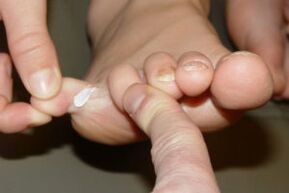
Fungus on the skin of the toes or mycosis of the foot is a dermatological disease.It affects people regardless of their age.
A common form of fungal mycosis on the toes is accompanied by symptoms unpleasant for the patient: itching, burning and peeling.
As the spores multiply, the fungus spreads to the skin of the feet and nails, penetrates the blood through microcracks, and spreads through the bloodstream to all internal organs.
The treatment program is based on concomitant diseases, location and type of infection.Prevention increases the likelihood of long-term remission.
To successfully get rid of harmful microorganisms, you need to know what foot fungus looks like, what causes it, and how to combat it.
What type of fungus develops on toes?
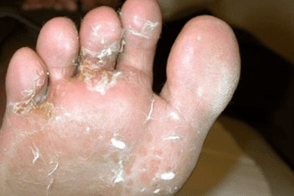
Mycosis of the toes is caused by the anthropophilic pathogenic microorganism Tinea pedis.
Less commonly, the causative agents of the disease are molds and yeast-like fungi of the genus Candida.
The fungus's favorite habitat is the folds of skin between the fingers, where it is warm and humid.
As the microorganism's spores multiply, they also spread under the toes and then throughout the foot.
Primary infection with the fungus occurs in public places: bathrooms, swimming pools, saunas, and gym locker rooms.
Microorganisms tolerate low temperatures and dry surfaces well;They can survive for a long time on clothing, carpets, shoes and, where appropriate, adhere to the skin of the feet.
Often, transmission of the microorganism occurs within the family, through the shared use of hygiene items, slippers and manicure utensils.
Once on the skin, microorganisms can remain inactive for a long time.The active growth of spores begins when favorable conditions occur, that is, when the immunity of an infected person decreases.
If the spores get on the skin of a person who suffers from a chronic illness or does not follow hygiene rules, the development of mycosis begins almost immediately.
It is especially important for patients suffering from chronic diseases to know what finger fungus looks like, since they are most often infected with the pathogen.
The risk group includes patients with the following problems:
- alterations in the functioning of the endocrine system;
- poor circulation in the extremities, varicose veins;
- flat feet, which contributes to increased friction with the skin;
- systematic stress;
- periods of hormonal changes in the body: pregnancy, menopause, adolescence;
- inflammation of the lymphatic system;
- Decreased postoperative or post-traumatic immunity.
The growth of the fungus is favored by sweating of the feet, shoes made of synthetic materials and microtrauma to the skin.
Favorable conditions for the growth of spores are created by poor nutrition: abuse of sweet, starchy, fatty foods and alcoholic beverages.
In children, toe fungus is rarely diagnosed.The main cause of mycosis in a child is lack of hygiene.
Symptoms and forms of the disease.
The development of a foot infection can be suspected in the initial stages, even before the appearance of visual signs of mycosis.The first sign of infection is peeling and itchy skin.
When microorganisms begin to penetrate the epidermis, the surface of the fingers becomes covered with small scales and cracks.
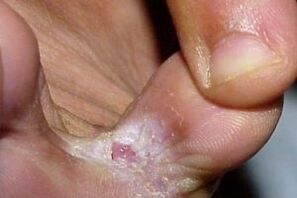
There is an unpleasant smell coming from the feet.Specific symptoms depend on the form of the disease:
- Erased.Small cracks and slight peeling form under the fingers and on their surface.
- Squamous-hyperkeratotic.There is intense itching, burning and white crusting on the fingertips.
- Intertriginous.Swelling, redness of the skin, formation of moisture between the fingers, peeling of the skin and formation of deep cracks occur.
- Dyshidrotic.It manifests itself as a rash of small blisters filled with serous fluid.Intense itching, formation of erosions at the site of the burst blisters and the entire foot becomes swollen.
Important!In the later stages of the disease, the fungus penetrates the surface of the nails and begins to change their color and structure.Nails become covered with colored spots, become deformed and crumble.
Diagnosis
When the first clinical signs of an infectious infection appear, a doctor should be consulted for a diagnosis.
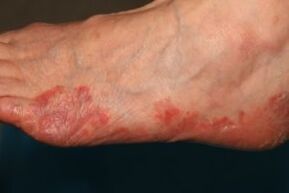
Despite the fact that the symptoms of the fungus are clearly visible even in the photo, only a specialist can identify the specific pathogen.
The patient is prescribed laboratory tests:
- Microscopy of skin particles.
- Bacterial culture from scrapings and blister fluid.
- DNA research of biomaterials.
- Blood test.
Treatment
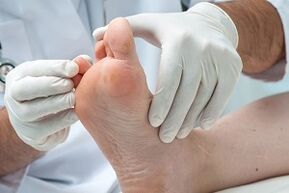
Treatment of finger fungus at the initial stage is not difficult.
The main measures are careful skin hygiene and treatment with topical antifungal drugs.
In the later stages of developing a fungal infection, doctors prescribe oral antifungal medications.
Home remedies and physiotherapy procedures are used as auxiliary drugs.
You can cure toe fungus by carefully following your doctor's recommendations, without reducing the time of taking prescribed medications.
medication
Pharmacological treatment involves the use of two groups of drugs:
- External preparations: ointments, creams, gels, sprays;
- Preparations for oral administration.
Important!The complex of therapeutic measures also includes a special diet, taking immunostimulants and means to restore intestinal microflora.When a secondary infection is associated with inflammation, ointments are also used.
Physiotherapy
Physiotherapeutic procedures are a complement to pharmacological treatment and accelerate the healing process:
- UV irradiation of the skin.The rays penetrate the skin to a depth of 0.6 mm and kill fungal spores found in it.The duration of the sessions is 15-20 minutes.In the early stages of infection, the use of UV irradiation eliminates the need for antifungal agents.
- Diathermy, amplipulse therapy, UHF therapy to improve peripheral circulation.
- Laser irradiation of the skin.Irradiation of the skin suppresses inflammatory processes, relieves itching and dries damp areas.
Traditional methods
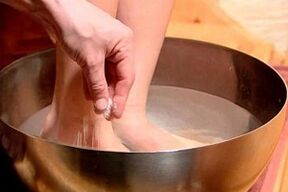
The initial stage of the fungus can be defeated with the help of folk recipes.The result will be evident with the usual procedures.
Folk remedies cannot destroy fungal spores on their own, but they have a certain fungistatic and antiseptic effect.
As a complement to medicines, preparations prepared according to folk recipes are quite effective.
The use of traditional medicine methods requires permission from the treating doctor.
According to reviews, the following provide effective assistance:
- Baths with soda and salt..1 tablespoon l.Salts and soda are dissolved in 2 liters of water, 10 drops of iodine are added.The feet are soaked in the solution for 15 minutes.The procedure is carried out before applying an antifungal agent.
- Baths with decoction of potato skins..The feet are soaked in the broth, reduced to a comfortable temperature for 20 minutes and then washed.The procedure is performed daily until the symptoms disappear.
- Baths with poplar bark decoction..100 grams of crushed bark are poured into 500 ml of boiling water and allowed to cool.The resulting infusion is added to the bath.
- garlic ointment.2 large cloves of garlic are crushed into a paste and mixed with 100 grams of butter.The ointment is applied to the steamed skin for 10 to 15 minutes a day for a month.
- Applications with decoctionmedicinal herbs.Pour 2 tablespoons of chamomile, chamomile and violet into a liter of boiling water and leave for 2-3 hours.A gauze soaked in the infusion is applied to the inflamed areas for 30 minutes a day.
- Compress with burdock leaf.A fresh burdock leaf is beaten with a hammer, the legs are wrapped, secured with a bandage and socks are put on.The compress is changed 2 times a day.The duration of the course is 21 days.
- Applications with carrot juice and vinegar.1 tablespoon l.Carrot juice and 9% vinegar are mixed and applied with a tampon to the inflamed areas.
- Egg and vinegar ointment.A raw egg is poured with 100 ml of vinegar essence (70%) and left for 7 days.The dissolved egg is mixed with 100 grams of butter and beaten.The resulting emulsion is lubricated on steamed legs, wrapped in film and put on socks.The procedure is repeated daily until the fungus is completely cured.
- Compress with ammonia.Add 1 tablespoon to 200 ml of water.l.ammonia, soak gauze in the solution, wrap your feet in it and put on socks.The compress is made at night and left until the morning.The total number of procedures is 9-10.
Complications
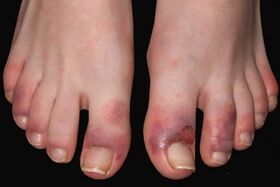
Toe fungus is not just a dermatological problem.
Spreading throughout the body and penetrating into the blood, the infection affects the internal organs and has a negative impact on the functioning of the entire body:
- Prolonged exposure to fungal toxins causes allergic reactions, exacerbation of bronchial asthma and dermatitis.
- Penetration into the blood disrupts the functioning of internal organs.
- Deep mycosis causes the progression of diabetes mellitus and, against its background, gangrene and bone infection may develop.
Prevention
An organism with a strong immune system can resist any infectious disease.Therefore, the main measure to prevent fungal infection is to maintain the body's defenses.
Following the following hygiene rules will help you avoid infection with fungal spores:
- daily change of socks and tights;
- use of breathable footwear made from natural materials;
- wearing special shoes (slippers, flip-flops) in public places;
- treat the skin of the feet with special protective sprays when visiting swimming pools, baths and beaches;
- perform a pedicure in a trusted salon, where the instruments are properly disinfected;
- trying on shoes in a store with disposable socks.
Special attention should be paid to preventing fungal reinfection after treatment.
To prevent spores from persisting on various surfaces, it is necessary to treat them antiseptically with a 45% vinegar solution.
It is recommended to replace the wipes and house slippers.
Treat the rest of the shoes from the inside with a vinegar solution and place them in a plastic bag for 12 hours.
Boil bedding, socks, stockings, and towels for 10 to 15 minutes in a soap and sodium solution.
Toe fungus cannot be left uncontrolled, so it is recommended to consult a doctor when the first symptoms appear.
Timely treatment will allow you to quickly cope with the fungus and avoid complications.Mycosis should be treated until the symptoms are completely eliminated and the skin recovers.